Happy Valentine's Day! I can't think of a better day to talk about how chronic illness affects my most important relationship: the one with my hubby of over 15 years.
Robert and I met when I was a freshman at UCLA in 1984. He and I were friends in 1988 when I was diagnosed with leukemia. While he didn't see much of my day-to-day struggle with month-long hospitalizations and chemotherapy treatments, he also didn't vanish like some of my other friends and family members did.
In 1990, when he first told me he loved me and wanted to go out with me, I freaked out. Between getting dumped by a boyfriend one month into cancer treatment and trying to cope with the changes life after cancer brought me, I wasn't ready to start dating yet. So I politely told him no.
Luckily for both of us, I changed my mind 5 years later when we reconnected and rekindled our friendship.
Today, looking back on our 15 years of marriage, I've just realized that I've been living with chronic illnesses severe enough to make me unable to work for almost 10 years now. So 2/3 of our marriage has been with my sickness, not health.
I told Robert when we started talking about marriage that there was a *possibility* that my health could get worse. We both knew I had chronic Hepatitis C infection, yet ironically, that's not what has disabled me for the last 10 years.
And not even a year into our marriage, I was faced with a new health concern. I was diagnosed with type 2 diabetes, which isn't causing me any serious problems at the moment, but does require a lot of effort on my part to manage it with diet, exercise, medications and follow-up medical care.
No, the big change happened in 2004 when a trip-and-fall accident started my journey with the constant, severe pain and debilitating fatigue of fibromyalgia. That accident also worsened a pre-existing, but not yet diagnosed, condition that had been around since the end of my cancer treatment -- dysautonomia. I've also developed new health problems, like sleep apnea, which is associated with fibromyalgia. Honestly, chronic pain makes all my other health problems worse, in various degrees, and makes managing them all more challenging too.
The other day I read a poster that said, "It's true that pain changes people. Not everyone knows this, not everyone sees this truth. Pain makes you let go of things you'd rather be doing. Sometimes it's OK that the only thing you did today was breathe. Pain changes you. But it can also make you stronger." Well, Robert's had an up close and intimate view of all the ways that pain has changed me...and he's seen a lot of unpleasant, undesirable and uncomfortable things in the last 10 years.
Let me be frank and to the point. I'm less frequently my cheerful self when my pain, fatigue and sleep-deprivation are at high levels. I need more help now and Robert is the one around who can help me. As much as I plan, pace, schedule, restructure activities and rest, my ability to participate in life's activities, from mundane daily chores to fun special events, is highly unpredictable. No wonder my hubby gets irritated with me, or rather my chronic illnesses, sometimes.
My chronic illnesses don't just effect me physically; chronic illness affects my concentration and memory too. Brain fog makes me forgetful, even when he just told me what he needed me to do. Try asking for help when all of a sudden you can't remember the word for the object you need your spouse to bring to you!
If I fall apart, physically, mentally or emotionally, it is Robert who is usually there to witness it. If I have a bad day, it impacts him the most. If I am in a really bad mood, he's most likely to caught up in it. If I can't do something, he's the one that will have to do it instead.
Yes, we have avoided being part of the statistic that shows 75% of marriages in which one spouse has chronic illness end in divorce. But no, our marriage hasn't always been easy. Ask Robert and he'll tell you we've had more than our fair share of bumps (or mountains!) in the road.
How have we done it? I think being friends for 14 years first and then dating, getting engaged and married helps.
I try to always be polite when asking for his help and grateful for the things Robert does for me. I try to tell him thank you frequently. I've learned to take a "time out" and retreat from his presence if I am really out-of-sorts. And I take the time to explain what is going on with me, often multiple times, until he really seems to understand.
Between explanations and witnessing my behavior over the last 10 years, I think he now really knows what is up with me -- sometimes better than I do!
One thing I've needed in the past several years is his help driving me to doctors' appointments. I have to say going to my appointments and being in the examination room with me has really been an education for him! He is now very annoyed that all the medical doctors and all the medical specialists can't put his wife back together again.
Finally, one thing that is both endearing and frustrating to me is his insistence that I do as much as I can myself. His urging is a good reminder that there are activities and better days when I can still do things without his help. Of course, when I need his help and he can't see that, it's quite frustrating. But I think it shows that he hasn't given up hope that one day I'll be the Selena he fell in love with again.
I hope some day I can get better too, for myself and for him, because living and loving with chronic illness makes it hard for both of us.
Showing posts with label relationships. Show all posts
Friday, February 14, 2014
Love -- In Sickness, not Health
Like this post? Then please...
Submit it to your favorite social sites.
Share it with PrintFriendly alternatives.
Posted by
Unknown
at
2/14/2014 09:47:00 AM
Tags:
dysautonomia
,
fibromyalgia
,
illness
,
love
,
my husband
,
relationships
Monday, November 15, 2010
Question of the Week: How has chronic illness impacted your marriage?
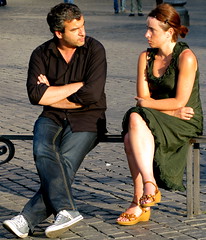
Image by Ed Yourdon via FlickrYesterday I had a heart-to-heart with my hubby about some things that were bothering me. While the details of the conversation are going to stay between me and my hubby, I will say that I found it took a lot of courage on my part to start the conversation. Which got me thinking about why that was...
One of the hardest parts about being disabled is how much more I rely on my hubby to help me, which is both a blessing and a burden. I've written before about how my hubby wants the old Selena back. It seems that my "new normal" is an issue that is being worked out by both of us individually and between us in our marriage. After six years, my disability's true impact on our life together can no longer be dismissed, denied or downplayed.
What can I say, reality bites ... and we are now getting to the business of dealing with it.
For my part, being so much more dependent on my husband makes me feel more vulnerable. It now feels scary to contemplate not having his love and support, which makes broaching big, heavy subjects akin to taking a huge risk; a risk that I might loose his support, even momentarily, and be left to face my burgeoning needs all on my own.
I hate that I even think this...
Before chronic illness I never gave a second thought to speaking up and getting into it over something that was important to me. Now I hesitate, partly because fighting takes so much out of me and partly because the ground I now stand on doesn't feel quite level anymore. I'm feeling off-balance in my relationship and feeling like I have more to lose now. I imagine my hubby might be feeling off-balance and feeling heavier under the weight of his new responsibilities.
Chronic illness has definitely made me more of a "taker" and less of a "giver" in our relationship.
Despite my perceived vulnerability, I am confident that we will work this out--eventually. For even when we fight, scream, throw our hands up and (temporarily) throw in the towel, we continue to be blessed with the ability to find our way back to each other. Which makes me a very fortunate spouse, since statistics show that for people living with chronic illness, up to 75% of their marriages end in divorce.
Chronic illness can make staying married or staying together a whole lot harder.
So this week I want to know: how has chronic illness impacted your marriage or long-term relationship? How do you and your partner cope? Please share with us your thoughts and ideas about this topic either here in a comment or at the Oh My Aches and Pains! Facebook page.
Like this post? Then please...
Submit it to your favorite social sites.
Share it with PrintFriendly alternatives.
Posted by
Selena
at
11/15/2010 06:03:00 AM
Tags:
coping
,
illness
,
marriage
,
my husband
,
relationships
Monday, May 24, 2010
The Power of Human Connection Is Not LOST on Me
Image by artnoose via Flickr
I watched the series finale of Lost last night. I admit that the last 10 minutes brought many tears to my eyes. I can't say that I have a better handle on all the mystery and mythology involved in this series than anyone else, yet I feel compelled to comment about the human connections created among the characters and the portrayal of the final journey they all embarked on at The End.
It amazes me that it took a TV show about a bunch of castaways on a tropical island to highlight how much we humans need each other. Granted, there is nothing like a smoke monster chasing you through the jungle or the reality that there is no McDonald's or grocery store around to get people working together. But I guess if you took away all our distractions--TVs, DVRs, cell phones, video games, etc.--we would eventually rediscover each others company and how much we really need each other too.
Despite all my distractions, life with chronic illness constantly reminds me how much I want and need other people in my life. You see, my experience of chronic illness is very much like living on an island, all by myself, with a smoke monster torturing me. In fact, at the moment, I can't think of a better way to describe living with chronic pain, chronic fatigue and all the other debilitating symptoms I experience every day.
What I miss most is being with other people for the majority of my day. In my previous post-illness life, I went to work with other people for eight hours a day and spent my evenings bowling in leagues with my husband or hanging out with my friends. Life with chronic illness has become synonymous with the word lonely; in many ways, I've lost my connections to other people because of chronic illness.
What caused me to cry all those tears at the end of the episode? Simply one big question: Can it be true that all the people that we lose along the way to death, divergence and distance can be found together in one place when we die? I found the concept utterly appealing. I found myself hoping that this little bit of fiction was the truth. It would be wonderful to regain all my lost relationships, all the ones that were important to me and helped me through the most crucial parts of my life, once my life was over. How wonderful it would be to move on to whatever the next phase of existence is surrounded by people I care about and love. Plus how great would it be to re-experience all those connections, all at the same time, once again?
No, the power of human connection is definitely not lost on me.
Like this post? Then please...
Submit it to your favorite social sites.
Share it with PrintFriendly alternatives.
Posted by
Selena
at
5/24/2010 08:00:00 AM
Tags:
chronic fatigue
,
Chronic pain
,
illness
,
LOST
,
relationships
Subscribe to:
Posts
(
Atom
)


![Reblog this post [with Zemanta]](http://img.zemanta.com/reblog_b.png?x-id=abf2650e-91bd-4a57-89ac-d1048ab28ba3)